

Introduction
Everyone has been to an ice cream stall. We all know the smallest amount of ice cream we can buy from a stall is “one scoop.” Have you ever gone to a market and bought a half egg or half candy? The answer is “No.” To buy or sell, a minimum unit is defined, and there is no exception in trading. In forex trading, the smallest standard price movement you can measure is a “pip.”
It is the smallest standard change in a currency pair’s exchange rate that can be observed.
If you are trading EUR/USD and the currency price moves from 1.3001 to 1.3002, then the change in value is said to be one pip.
Definition of pip
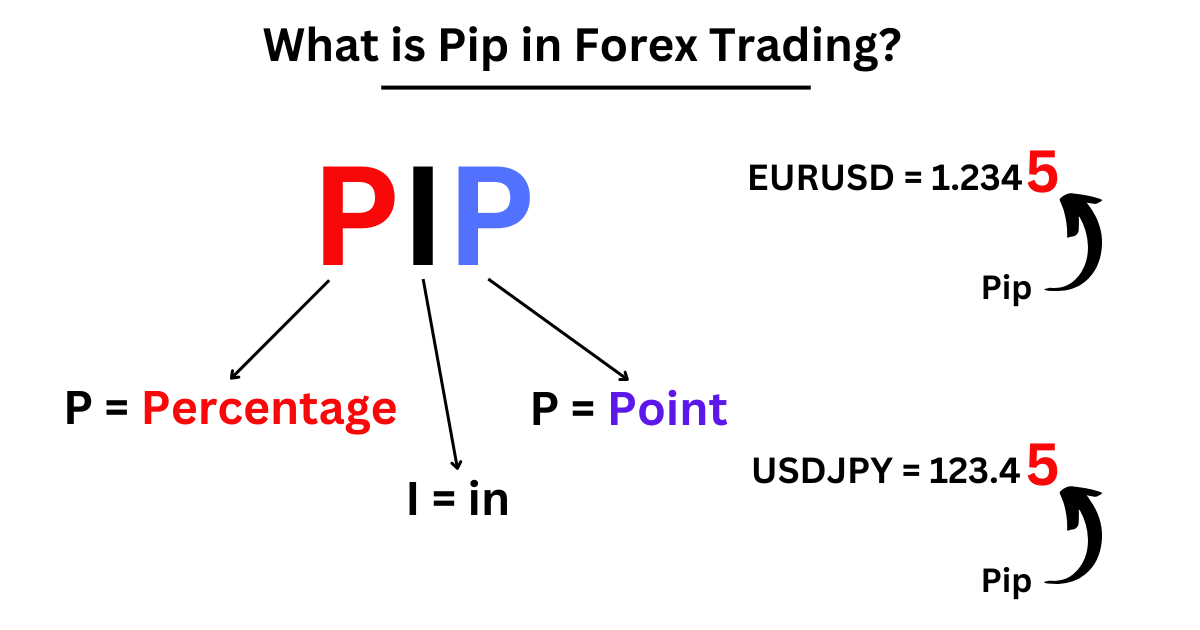
The word pip is an acronym, and its full form is:
P = Percentage
I = In
P = Point (or Price Interest Point)
A pip is defined as “the smallest standard price change in a currency pair’s exchange rate.”
Key characteristics of a pip:
- It is the smallest standard price increment a currency pair exhibits.
- It is usually the fourth decimal place (0.0001), except in Japanese Yen (JPY) pairs, where a pip is the second decimal place (0.01).
- The monetary value of a pip varies depending on the lot size (trade volume) and currency pair.
- One pip (0.0001) equals 1/100th of one percent (1 basis point).
How to calculate a pip?
In order to calculate the monetary value of a pip, you need:
- Pip size (0.0001 for most pairs, or 0.01 for JPY pairs)
- Exchange rate of the currency pair
- Trade volume (lot size) in units of the base currency
Using these three inputs, we can calculate the pip value:
Pip Value (in Quote Currency) = Pip Size × Trade Volume
Pip Value (in Base Currency)  = (Pip Size / Exchange Rate) × Trade Volume
Examples
In the case of EUR/USD
If we are trading EUR/USD with a trade size of one standard lot (100,000 units) where the EUR/USD exchange rate is 1.0870 (meaning €1 = $1.0870, or $1 = €0.92):
| One pip = 0.0001 Trade volume = 100,000 units (1 Standard Lot) Pip Value in USD (Quote Currency) = 0.0001 × 100,000 = $10.00 per pip Pip Value in EUR (Base Currency) = (0.0001 / 1.0870) × 100,000 = €9.20 per pip |
In the case of GBP/USD
If we are trading GBP/USD with a trade size of 10,000 units (1 mini lot) where the GBP/USD exchange rate is 1.24, the pip value is calculated as:
| One pip = 0.0001 Exchange rate = 1.24 Trade volume = 10,000 units (0.10 Mini Lot) Pip Value in USD (Quote Currency) = 0.0001 × 10,000 = $1.00 per pip Pip Value in GBP (Base Currency) = (0.0001 / 1.24) × 10,000 = £0.81 per pip |
In the case of USD/JPY
There are only two decimal places after the decimal point when dealing with JPY pairs, so one pip in a Japanese Yen currency pair is 0.01. For a standard lot (100,000 units) of USD/JPY at an exchange rate of 135.00, the pip value in USD is calculated below:
| One pip = 0.01 Exchange rate = 135.00 Trade volume = 100,000 units Value of the pip (in USD) = (0.01 / 135) × 100,000 = $7.41 per pip (or ¥1,000 JPY) |
Significance and usage of pip unit in trading
A pip is the foundation of forex price measurement and trade sizing. Its significance can be seen in three core areas:
Risk management: Knowing the pip value is essential for calculating your exact position size and setting your stop loss so you never risk more than your planned percentage per trade.
Estimation of trade value: A pip measures every incremental profit or loss on an open currency position, allowing you to quantify reward-to-risk before entering the market.
Execution of a trade: When trading through a broker, transaction costs—whether fixed or variable spreads—are quoted and charged in pips.
How to calculate position size using Pips
Pips play a vital role in calculating your position size before executing a trade. To determine your position size (in lots), you need to know:
- Your dollar risk amount (Account Balance × Risk %)
- Your stop-loss distance in pips (the gap between entry and stop loss)
- The pip value per standard lot for the currency pair
Position size is determined by the following formula:
Position Size (Standard Lots) = Risk Amount ($) / (Stop Loss in Pips × Pip Value per Standard Lot)Example:
Suppose you are willing to risk $100 on a trade where the gap between your entry and stop loss is 40 pips, and the pip value per standard lot is $10. We can calculate your position size using the formula above:
Risk Amount = $100
Stop Loss (Gap in pips) = 40 pips
Pip Value (per standard lot) = $10
Position Size = $100 / (40 × $10)
Position Size = 100 / 400 = 0.25 standard lots (2.5 mini lots)
So you should open a position size of 0.25 lots ($2.50 per pip × 40 pips = $100 risk) to stay strictly within your risk management plan.
Pip value in Gold
While most forex currency pairs use a pip size of 0.0001, in Gold (XAUUSD) most brokers quote prices to two decimal places, so 1 pip = $0.01. Gold is traded in troy ounces, and one standard lot equals 100 troy ounces ($1.00 per pip). If an ounce of Gold moves from $2,017.00 to $2,018.00 (a $1.00 or 100-pip move), a 1.00 standard lot position will gain or lose $100.
Pip value in crypto
Dealing with cryptocurrencies is slightly different from traditional forex pairs. In crypto trading, movements are commonly measured in dollar/cent ticks or native blockchain subunits (such as satoshis for Bitcoin).
On most crypto CFD brokers, a 1-pip or 1-point price movement on major coins is quoted at $1.00 or $0.01 depending on the asset’s price scale.
On the Bitcoin blockchain itself, a satoshi is the smallest native unit of Bitcoin:
One satoshi = 0.00000001 BTC
Pip value in US oil
The size of 1 pip in crude oil (USOIL / XTIUSD) is $0.01 per barrel. On an institutional US oil contract of 1,000 barrels, each 1-pip ($0.01) change equals $10.00, and a $1.00 per barrel (100-pip) move equals $1,000. On retail CFD brokers where 1 standard lot equals 100 barrels, 1 pip ($0.01) equals $1.00, so a $1.00 per barrel (100-pip) move equals $100.
The bottom line
A pip has a core value when executing any trade in forex because:
- It measures the exact price movement in a currency pair or commodity
- It allows you to quantify your dollar risk per trade
- It is required to calculate your exact lot size before entering a trade
- It measures the spread and transaction cost of a trade
At the end of the day, a proper understanding of pip size and pip value plays a vital role in protecting your capital and managing your trading risk consistently.